


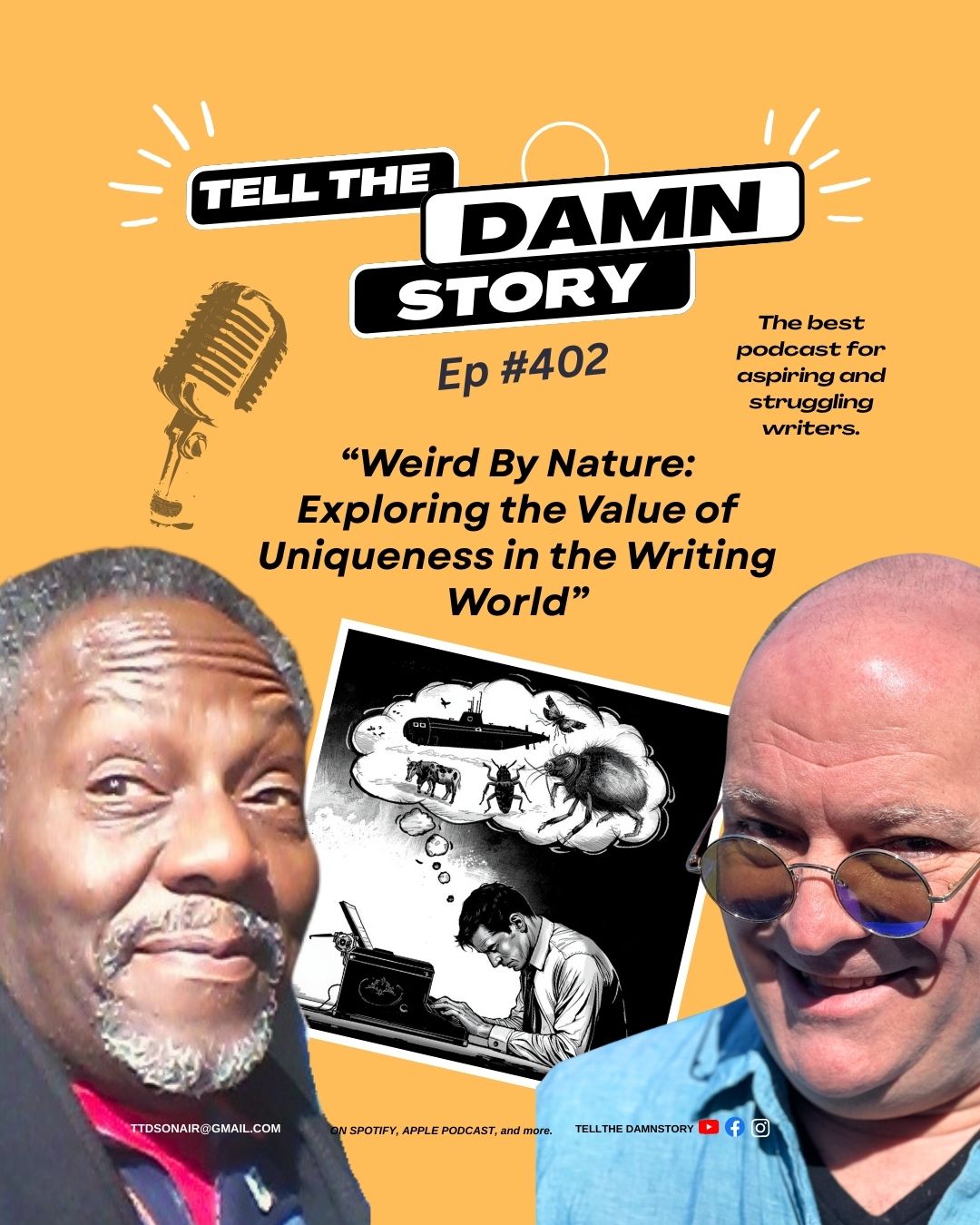
TTDS #402: "Weird By Nature Exploring the Value of Uniqueness in the Writing World"
by AlexAre Writers Allowed to Be Weird?
Let’s start with a simple truth:
If you live long enough, someone will tell you that what you think, feel, or create is weird.
Now imagine you’re a writer.
You’re not just thinking your thoughts —
you’re putting them on the page.
You’re sharing them with strangers.
You’re risking interpretation, misinterpretation, and judgment.
That can be terrifying.
In Episode 402 of Tell The Damn Story, we asked:
Do writers need permission to be weird?
And what does “weird” even mean?
The Purple Cows and Aliens Problem
Alex told a story about working with fourth graders assigned to write a play about the women’s suffrage movement.
Instead, the students wrote about… purple cows and aliens.
The administration dismissed it as nonsense.
But here’s the better question:
Why did the students process historical material and reimagine it that way?
Metaphor.
Translation.
Creative transformation.
Jazz sounds chaotic until you understand the structure underneath.
Impressionist paintings look strange until you step back.
Weird isn’t always nonsense.
Sometimes it’s a different lens.
Human History Is Already Weird
Let’s be honest:
Slavery is weird.
War is weird.
The idea that neighbors can turn on each other over belief systems is weird.
Human behavior is strange.
So why are we shocked when art reflects that strangeness?
When a writer creates:
A cockroach as a protagonist (Kafka)
Talking animals staging revolution (Animal Farm)
Aliens and time loops (The Twilight Zone)
A man who finally has time to read — only to lose the ability
That isn’t nonsense.
It’s commentary.
Weird as Metaphor
Artists have always used stylized, symbolic storytelling to explore uncomfortable truths.
Rod Serling used science fiction to discuss prejudice and fear.
George Orwell used farm animals to explore political corruption.
Franz Kafka used absurdity to express alienation.
On the surface, it looks strange.
Underneath, it’s painfully human.
Weird is often just truth wearing a costume.
The Line in the Sand
Let’s clarify something important:
Being weird does not mean causing harm.
Creative expression is not an excuse for cruelty or incitement.
There’s a difference between:
Exploring uncomfortable ideas
And encouraging real-world violence or hatred
Writers push boundaries.
They do not weaponize them.
Why Suppressing Your Weird Hurts You
One student wanted to make a short film about a deeply personal cultural experience.
He received pushback because the topic was politically sensitive.
If he had backed down, he would have lost:
The chance to express something meaningful
The growth that comes from executing a project
The collaboration of a creative team
The recognition that followed
More importantly, he would have silenced himself.
When writers suppress their weirdness, they suffocate their voice.
Everyone Is Weird to Someone
Creatives are weird to accountants.
Accountants are weird to creatives.
Plumbers are weird to painters.
Perspective defines normal.
If you are different, someone will resist it.
That does not make you wrong.
It makes you distinct.
Your Weird Is a Door
Innovation comes from ideas that initially sound ridiculous:
“Let’s record sound on vinyl.”
“Let’s put a man on the moon.”
“Let’s tell a story about a man turning into an insect.”
Weird ideas become breakthroughs because someone says:
“What if?”
If you shut down every strange instinct you have, you shrink your creative range.
If you explore it thoughtfully, responsibly, and honestly, you expand it.
Final Thought
Your weirdness is not a liability.
It is a possibility.
If you feel something strongly —
If you see the world from an angle others don’t —
If your metaphors seem unusual —
Explore them.
Just don’t use them to harm.
Tell the story.
Let others decide what it means.
🎧 Watch episode 402 of Tell The Damn Story on YouTube, available now.
Be weird.
Be thoughtful.
Be brave enough to write what only you can write, and tell your own damn story.
Comments & Upvotes